Islands of Croatia
Unique and Beautiful
There are 1244 large islands, islets, and rocky reefs situated along Croatia's long coastline. Of these, 49 of are inhabited, each having its own unique history and cultural aspects. Some of the popular islands are Hvar, Mljet, Korcula, Brac and Trogir.

Photo from boat entering the port of Hvar
Hvar is often called the party island with long night parties in the many clubs and on lavish yachts in the harbor. Expect to be out to the early morning hours to truly experience the nightlife. The crystal-clear water and views of the lit-up Fortress Fortica help create the party atmosphere vibe.

Photo showcasing the clear blue sea in Hvar

Photo of Hvar with Fort Fortica in the background
Although nightlife is popular here, the best thing to do in Hvar is to hike up to Fort Fortica and enjoy the amazing views from there. The fort dates back to at least 1278, when construction began under Venetian rule. There is a student entry fee discount, along with a bar for refreshments.
Photo below of CSU student Brody Jones enjoying a refreshment on top of the Fortica Fort walls

Mljet is the 8th largest island in Croatia and hosts a national park on the entire western side, making this island truly unique. There are vast areas to explore by hiking, kayak, boat, swimming, and my favorite: renting an electric bike and touring the area around the two saltwater lakes. There is a bar along the way with beachfront bars at the end of the quaint harbor.
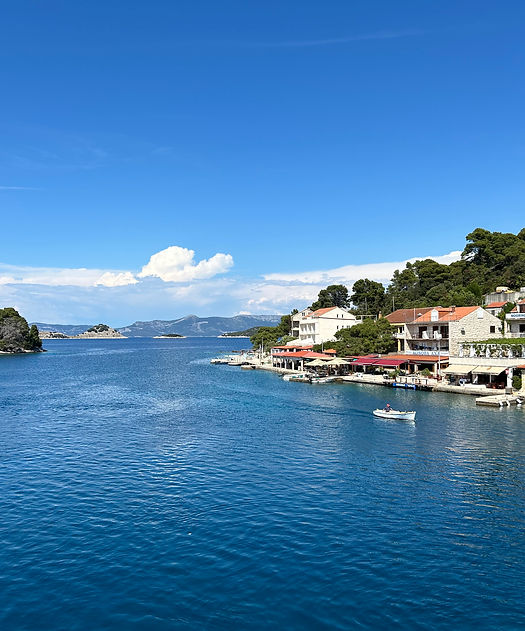

Photo of Mljet harbor, restaurants, bars, and swimming areas
Photo of CSU student Nick Smith taking a break from biking along the Mljet lakes
The island of Korcula is the quaintest of all the islands, although it is the second most populated in Croatia. The old town is rich in character and history, with amazing views with every footstep
Photo below entering the quaint island of Korcula


Photo from the old town city tower overlooking the Korcula harbor
Photo below of Korcula old town center area

A captivating part of history resonates in Korcula, as Marco Polo (1254-1324) was held here as prisoner of war in one of the greatest naval battles of the Middle Ages, captured off the coast with the Venetian Navy. He transcribed his famous book here, The Travels of Marco Polo.
Photo by Croatian CSU course guide, Karmen, taken of CSU student David Bohler atop the Marco Polo Museum and claimed birthplace of Polo in Korcula
Photo of the many quaint walkways in old town, Korcula


Korcula was part of the Genova Republic when Polo, commanding a Venetian naval vessel, was captured. A fellow prisoner, Rusticello, wrote the book as Polo gave his account of being the first European traveler to visit the Mongol Empire, under Kublai Khan. If the Venetian navy had won that battle, Polo might never have had his book written on the famous island of Korcula.
Photo of David Bohler standing in the courtyard of Marco Polo's childhood home in Venice. Photo taken July, 2023 by fellow CSU student, Cooper Enright

Korcula is also credited as the actual birthplace of Polo, although this is controversial. Records do show at the time of his birth, Polo did have family on Korcula active in shipbuilding. Also, Polo’s father, being a trader, would have probably conducted business here. Whether Polo was born in Korcula or not, it is certain that he grew up in Venice, leaving there at 17 to travel to China for three years.

Photo of Brac harbor
The island of Brac is unique as a contributor to industry versus mainly tourism. The economy thrives with tourism, fishing, agriculture, and white limestone. It is the third largest island in the Adriatic and has the highest peak (2,560 ft). Much of the agriculture consists of olive trees, where the olive oil produced here has Protected Designation of Origin status, like Champaigne in France.
The olive oil produced in this area is award winning and considered the best in the world. Students studying abroad can earn two liters a day by harvesting olives during the months of October and November. Free boarding and meals are included. This family run business since 1864, has converted the original pressing facility into a museum and restaurant where visitors can receive a tour and sample olive products.
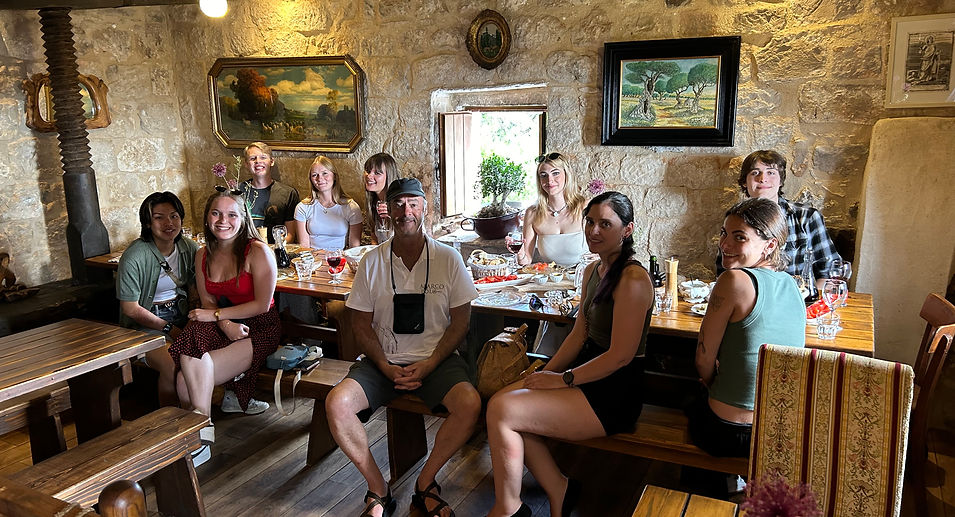
Photo of CSU students at the Olive Oil Museum in Brac taken by the museum owner who is a decendent of the original owners in 1864, when freshly picked olives were ground and pressed
The white limestone quarry is still active and the stones from there are used in many locations to include Diocletian’s Palace in Split, Croatia.

Photo of white limestone from Brac, used to construct Diocletian's Palace in Split during the fourth century
Trogir, although barely an island separated from the coast by two small bridges, is a definite place to visit, especially for history majors. This medieval city carries such global cultural significance, it is UNESCO protected. A major attraction here is Fort Kamerlengo, which finished construction in 1437 by the Venetians. It was damaged during WWII when a German military boat was targeted next to it.

Photo of Fort Kamerlengo taken from Trogir harbor
Photo of CSU Professor Wolfgang, students, and course guide, Karmen, atop the Kamerlengo Fortress overlooking the Trogir harbor. Photo taken by Trogir tour guide, Antea

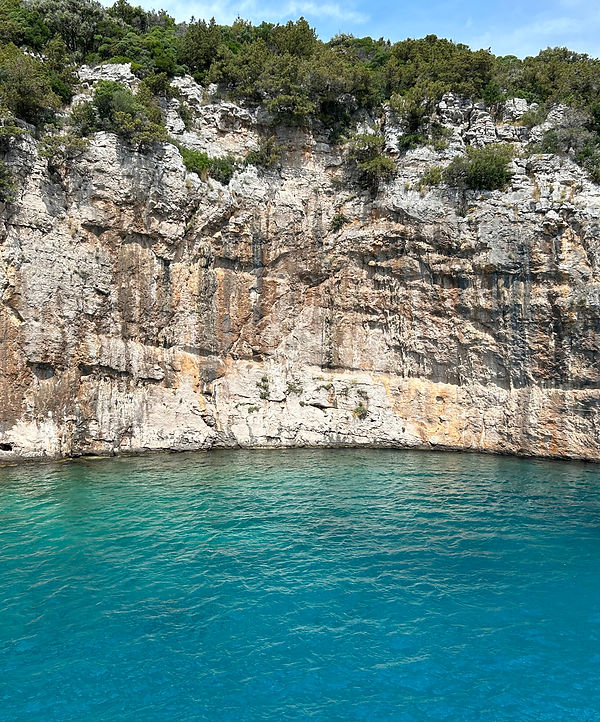
Traveling to all these islands or others is best by boat, giving the opportunity to enjoy the hidden coastal spots along the way to swim, sunbath, or cliff dive!
One of many spots to jump into
the beautiful Adriatic Sea
CSU students, Angelique Padres videos David Bohler cliff diving along the Croatian island chain
Photo of the best place to cliff dive along the Adriatic Sea - cove approaching the Island of Brac
Photo from boat approaching the Brac Island, with white limestone peaks